Contents
Best Espresso Machines for Small Kitchens (2026)
TL;DR: The best espresso machine for a small kitchen fits under 14 inches tall, pulls a proper shot, and doesn’t eat your counter. The De’Longhi Dedica EC685 is the top pick for most people — 6 inches wide, sub-$150, and genuinely capable. If you want a built-in grinder in the same footprint, the Breville Barista Express is the step-up that earns its extra inches.
What Makes an Espresso Machine “Small Kitchen Ready”?
Direct answer: Width and depth matter more than height. Look for machines under 7 inches wide and 12 inches deep. A single-boiler thermoblock machine heats fast and takes up minimal internal volume — that’s why compact machines almost always use them.
 Photo: Nguyễn Khanh via Pexels
Most countertop espresso machines are 10–14 inches wide. In a galley kitchen or apartment, that’s your cutting board, your kettle, and your machine all fighting for the same 24 inches of counter. The machines below were chosen because they’re genuinely narrow or shallow — not just “compact” in marketing copy.
Key dimensions to check:
- Width — the primary constraint in narrow kitchens
- Depth — counts when counter space is shallow
- Height — rarely the issue unless you have low cabinets (under 14“)
A thermoblock or thermocoil heats water on demand in seconds, skipping the bulky single or dual boiler. That’s the engineering reason compact machines exist at all.
The 5 Best Espresso Machines for Small Kitchens
1. De’Longhi Dedica EC685 — Best Overall Compact Machine
Direct answer: At 6 inches wide, the Dedica EC685 is the narrowest full-featured espresso machine you can buy. It pulls 15-bar shots with a proper portafilter, steams milk adequately, and costs under $150. Nothing else at this price matches its footprint-to-capability ratio.
 Photo: Nate Biddle via Pexels
The Dedica uses a thermoblock that hits brew temperature in 35 seconds. The portafilter is a proprietary 51mm — smaller than the 58mm standard, which means aftermarket accessories are limited, but De’Longhi includes pressurized baskets plus an unpressurized single-wall basket for those grinding fresh.
The steam wand is the one real compromise: a Panarello-style frother that auto-injects air. Acceptable for a cappuccino, frustrating if you want to practice latte art.
| Spec | Value |
|---|---|
| Width | 6.0 in |
| Depth | 13.0 in |
| Height | 12.7 in |
| Boiler type | Thermoblock |
| Portafilter | 51mm proprietary |
| PID | No |
| Pump | Vibratory 15-bar |
| Burr size | N/A (no grinder) |
2. Breville Barista Express BES870XL — Best Compact All-in-One
Direct answer: The Barista Express packs a 54mm portafilter, a 9.7oz hopper, and a conical burr grinder into a machine that’s 12.5 inches wide. It’s not small by compact standards, but it replaces two appliances — which is often the better trade-off in tight kitchens.
 Photo: Mizuno K via Pexels
The integrated grinder means one power cord, one footprint, one less thing. The 54mm portafilter is non-standard but widely supported by aftermarket baskets. PID temperature control is a genuine differentiator at this price — most sub-$700 machines skip it entirely.
Grind adjustment uses a dial with 18 settings. It’s not a replacement for a standalone Niche Zero, but it’s accurate enough for espresso and will outperform any blade grinder you’re currently using.
| Spec | Value |
|---|---|
| Width | 12.5 in |
| Depth | 12.3 in |
| Height | 15.75 in |
| Boiler type | Thermocoil |
| Portafilter | 54mm |
| PID | Yes |
| Pump | Vibratory 15-bar |
| Burr size | 40mm conical stainless |
3. Nespresso Vertuo Pop — Best for Absolute Minimum Footprint
Direct answer: 5.5 inches wide, one button, capsule-based. If counter space is genuinely scarce and espresso quality is secondary to convenience, nothing is smaller or simpler. Not for espresso purists.
 Photo: cottonbro studio via Pexels
The Vertuo Pop uses centrifugal extraction — spinning the capsule at up to 7,000 RPM — rather than true 9-bar pump pressure. The result is crema-like foam over a less dense shot. If you’re adding milk, most people can’t tell. If you’re pulling a straight doppio for the flavor, you’ll notice.
What it offers in return: no grinding, no tamping, 20-second heat-up, minimal maintenance, and a footprint smaller than a paperback novel.
4. Gaggia Classic Pro — Best Compact Semi-Pro Machine
Direct answer: The Gaggia Classic Pro uses a commercial-style 58mm portafilter and a real solenoid valve in a machine that’s 9.4 inches wide. It’s the smallest machine that behaves like professional equipment.
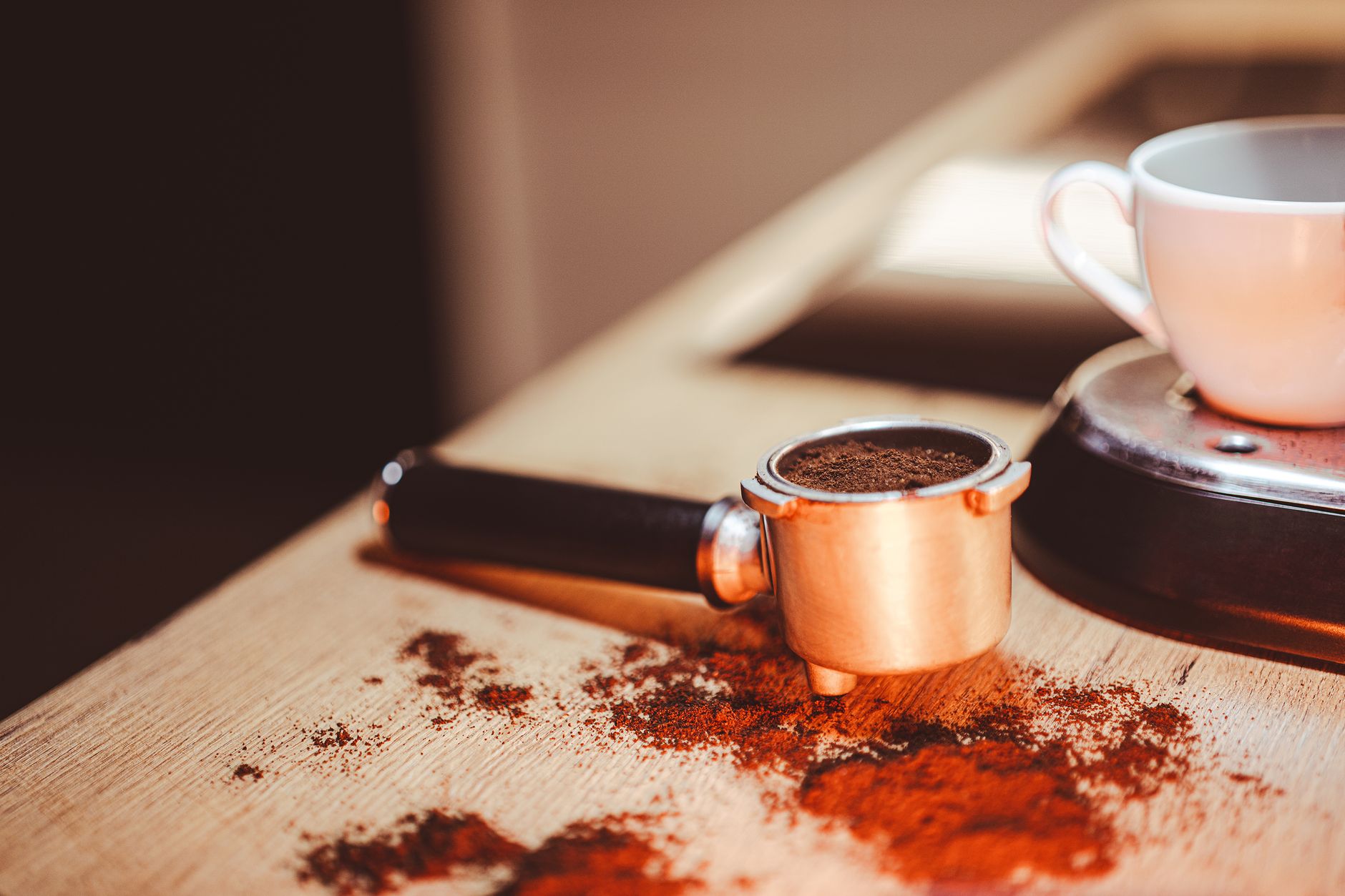 Photo: Jakub Zerdzicki via Pexels
The 58mm grouphead means every aftermarket basket, portafilter, and tamper fits without an adapter. The three-way solenoid valve releases pressure after the shot — wet pucks, mess-free. The steam wand is a single-hole commercial tip: harder to learn than a Panarello, but capable of proper microfoam.
No PID from the factory, but the Gaggia Classic Pro is the most-modded machine in this price range — a PID kit runs around $50 and takes 90 minutes to install.
| Spec | Value |
|---|---|
| Width | 9.4 in |
| Depth | 17.5 in |
| Height | 14.2 in |
| Boiler type | Single boiler aluminum |
| Portafilter | 58mm standard |
| PID | No (moddable) |
| Pump | Vibratory 15-bar |
| Burr size | N/A (no grinder) |
5. Rancilio Silvia — Best Compact Prosumer Machine
Direct answer: At 11.4 inches wide with a commercial grouphead and brass boiler, the Silvia is the most capable single-boiler machine under $800. It rewards patience and a good grinder.
The Silvia’s brass boiler holds temperature more consistently than aluminum, and the 58mm commercial grouphead handles any puck prep approach. The machine doesn’t have a PID, which means temperature surfing — pulling the shot at the right moment in the boiler’s heating cycle — is the skill to learn.
With a $50–100 PID mod, it’s as stable as machines costing twice as much. Without one, it still produces excellent espresso in the hands of someone willing to learn the quirks.
Full Comparison Table
| Machine | Price | Width | Boiler | Portafilter | PID | Best For |
|---|---|---|---|---|---|---|
| De’Longhi Dedica EC685 | ~$140 | 6.0 in | Thermoblock | 51mm proprietary | No | Tightest counter, beginner |
| Nespresso Vertuo Pop | ~$80 | 5.5 in | Thermoblock | Capsule | N/A | Absolute minimum footprint |
| Gaggia Classic Pro | ~$449 | 9.4 in | Single boiler | 58mm standard | No | Upgrade path, semi-pro |
| Breville Barista Express | ~$699 | 12.5 in | Thermocoil | 54mm | Yes | One-appliance solution |
| Rancilio Silvia | ~$745 | 11.4 in | Single boiler brass | 58mm standard | No | Prosumer quality, tight space |
Verdict by User Archetype
Milk drinker / cappuccino-first: De’Longhi Dedica with a milk frother upgrade, or the Barista Express if you want grinding built in. The Panarello on the Dedica is passable; the Barista Express steam wand is better.
Espresso purist: Gaggia Classic Pro if you want 58mm compatibility at lowest cost. Rancilio Silvia if you want the most capable single-boiler in this footprint and you’ll eventually add a PID. Either needs a good external grinder.
Convenience-first: Nespresso Vertuo Pop ends the conversation. If capsules are an acceptable operating cost, nothing competes on simplicity in this size class.
→ See Also
- The Complete Guide to Espresso Machines (2026)
- Best Espresso Machine Under $200 (2026)
- Best Espresso Machine Under $500 (2026)
FAQ
Does a compact espresso machine make worse espresso than a full-size machine? Not necessarily. The De’Longhi Dedica and Gaggia Classic Pro pull shots competitive with machines twice their size. The main compromises in compact machines are boiler volume (affects steaming capacity, not shot quality) and portafilter size (limits basket selection). A good grinder matters far more than machine footprint.
What is the narrowest espresso machine with a real portafilter? The De’Longhi Dedica EC685 at 6 inches wide. It uses a 51mm proprietary portafilter, which is smaller than the 58mm commercial standard but still accepts unpressurized baskets for fresh-ground espresso. The Nespresso Vertuo is narrower but uses capsules, not a portafilter.
Can I use a compact espresso machine under a cabinet? Most compact machines are 12–15 inches tall. Standard upper cabinets sit 18 inches above the counter, leaving 3–6 inches of clearance — enough for most machines here, but not enough to swing open a top-fill water tank. Check your cabinet height and the machine’s fill method (front-fill vs. top-fill) before buying.
How much counter space does an espresso machine actually need? Plan for the machine’s footprint plus 4–6 inches in front for the portafilter and cup. A De’Longhi Dedica needs roughly 6 × 13 inches of actual counter plus 5 inches of working space in front — about one square foot of functional zone. A Barista Express with its grinder needs closer to 12 × 12 inches plus front clearance.
Is a thermoblock machine good enough for real espresso? Yes, with a caveat. Thermoblock and thermocoil machines heat water fast and maintain stable flow temperature for a single shot. Where they fall short: back-to-back shots without a rest period, and steaming milk immediately after pulling a shot (the temperature recovery time is longer than a dedicated boiler machine). For one or two drinks at a time, thermoblock performance is fully adequate.
Should I buy an all-in-one machine or a separate grinder? A separate grinder almost always wins on espresso quality. The Breville Barista Express is the exception worth considering in tight kitchens — it eliminates a second appliance and is genuinely capable. If you have room for both, a Gaggia Classic Pro paired with a mid-range burr grinder (Baratza Encore ESP, DF54) will outperform any all-in-one at the same total price.
Editorial methodology: Assessments are based on manufacturer specifications, published user reviews, and editorial research. Physical hands-on testing is noted explicitly where it occurred. Rankings reflect our editorial judgment and are not influenced by affiliate commission rates. Full editorial policy · Affiliate disclosure