Contents
Comandante C40 Review: Worth the Price in 2026?
TL;DR: The Comandante C40 is the best manual grinder for espresso and filter coffee under $300 — full stop. Grind consistency rivals electric burr grinders costing twice as much. If you brew at home and care about cup quality, it’s worth every cent. If you just need morning drip, a $50 option gets you 80% there.
Comandante C40 Review: What You Actually Get
Direct Answer: The C40 delivers competition-grade grind consistency in a hand grinder, with Swiss-engineered “Red Clix” steel burrs that produce tight particle distribution across every brew method. It’s expensive for a hand grinder, but it outperforms most electric grinders in its price class on grind uniformity.
 Photo: H. Hümâ Yardim via Pexels
The Comandante C40 has been the gold standard manual grinder since its first generation. The current iteration uses 38mm hardened steel conical burrs with a proprietary alloy Comandante calls “Nitro Blade.” These aren’t marketing words — blind cuppings and particle size analysis consistently show less fine particle scatter (fewer “fines”) compared to competitors at similar price points.
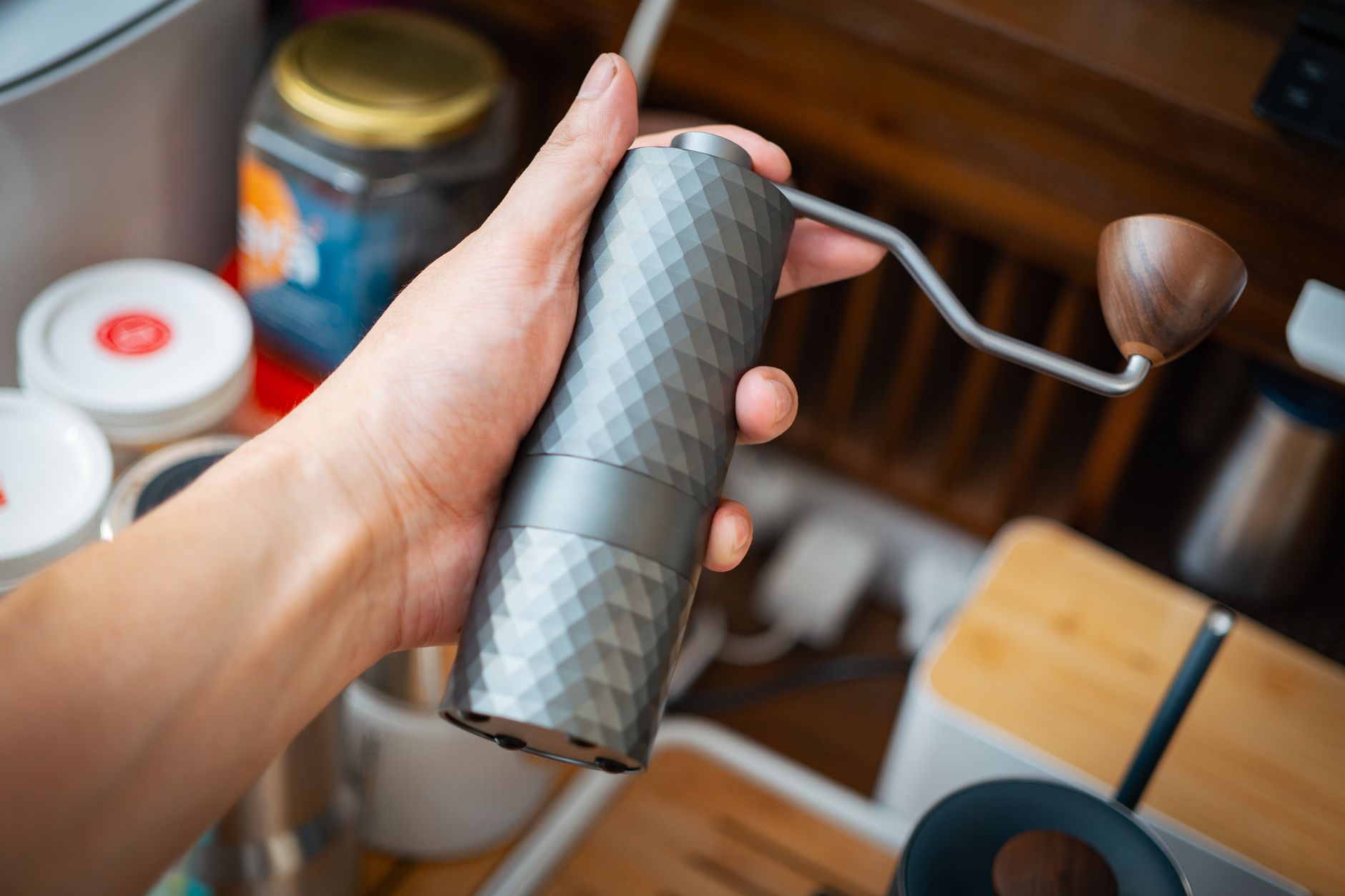
Build quality is unmistakable: borosilicate glass catch jar, precision-machined aluminum body, sealed ceramic bearings. The grinder weighs 540g and feels like a precision tool, because it is one.
The Red Clix system lets you adjust grind in half-click increments (vs. one full click on standard C40s). For espresso dialing, that granularity matters — the difference between channeling and a clean shot can be half a click.
Grind Quality Across Brew Methods
Direct Answer: The C40 excels at filter brewing (V60, Chemex, Aeropress) and performs well at espresso — though fully manual espresso grinding takes 40–60 seconds of hard cranking per shot. For pourover, it’s exceptional at any price.
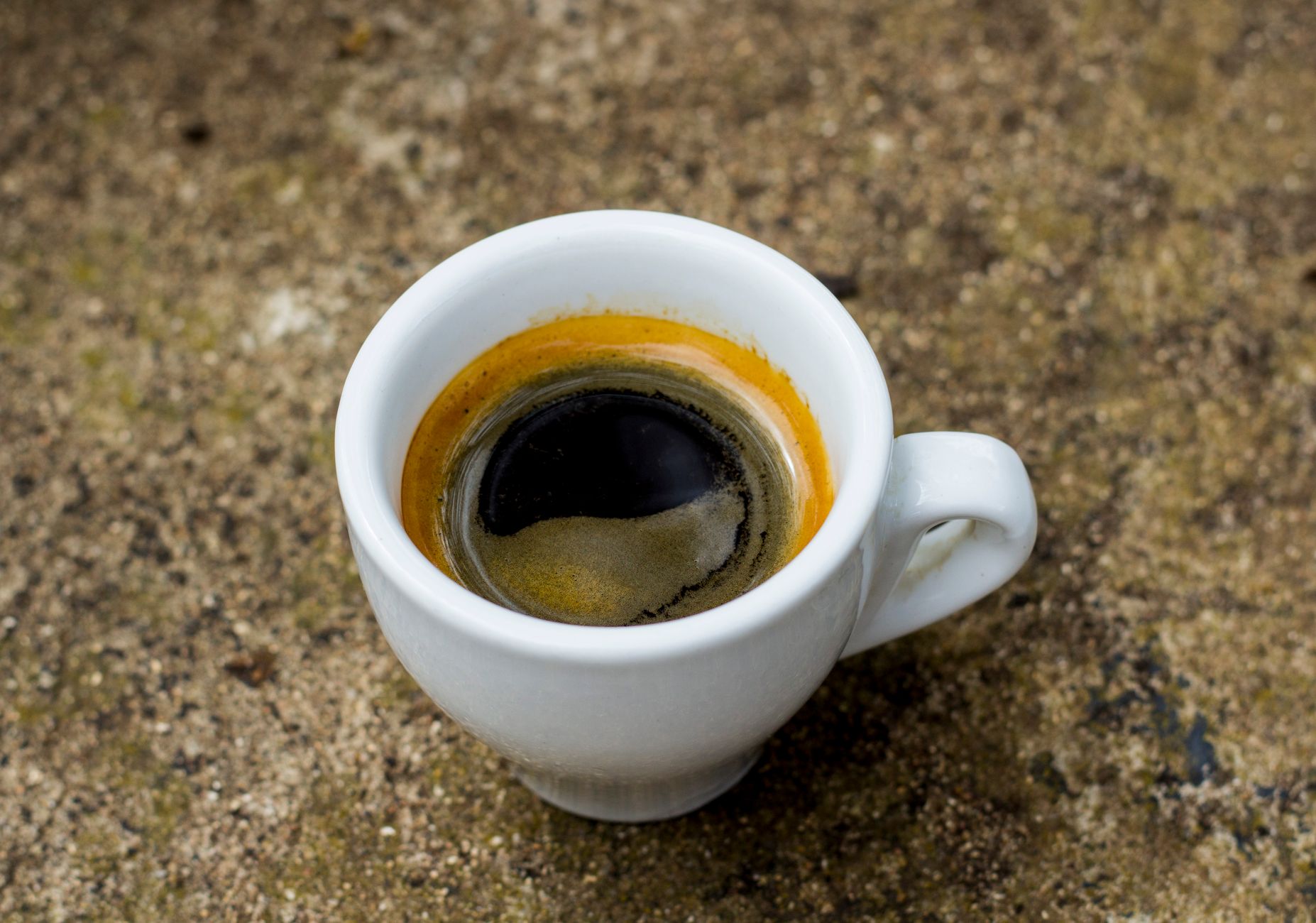 Photo: Johnny Willz via Pexels
Espresso
Espresso is where the C40’s limits show — not in quality, but in effort. Tight espresso grinds (~300–350 microns) require 50+ rotations per 18g dose. Your wrist will notice. The grind distribution is excellent and absolutely capable of pulling 9-bar extractions with golden crema, but compare it to a $400 electric like the Niche Zero and the convenience gap is real.
The Red Clix version has ~30 clicks of usable espresso range. That’s enough to dial in most machines, though single-boiler machines with temperature variability may need frequent readjustment.
Filter and Pourover
 Photo: Tony Wu via Pexels
This is where the C40 dominates. Medium-coarse filter grinds (600–800 microns) take under 30 seconds per 25g dose. Particle distribution at these ranges is strikingly uniform — you’ll see the difference in cup clarity. Pourovers brewed with C40-ground coffee have noticeably cleaner finish and brighter acidity than those ground on entry-level electrics.
Aeropress and Batch Brew
Both are easy wins. Aeropress doses (15–20g) grind in under 20 seconds. Batch brew works fine, though grinding 50g+ for a full pot by hand gets old quickly. The C40 isn’t designed for volume.
C40 vs. Competitors: How It Stacks Up
| Grinder | Price | Burr Size | Burr Material | Best Method | Portability |
|---|---|---|---|---|---|
| Comandante C40 | ~$230 | 38mm | Nitro Blade Steel | All-around | Yes |
| 1Zpresso JX-Pro | ~$170 | 38mm | Stainless | Filter/Espresso | Yes |
| Timemore Chestnut C3 | ~$90 | 38mm | Stainless | Filter | Yes |
| Niche Zero (electric) | ~$700 | 63mm | Steel | Espresso | No |
| Baratza Encore ESP | ~$250 | 38mm | Steel | Espresso | No |
The 1Zpresso JX-Pro is the closest competition. At $60 less, it gives up marginal grind consistency and build quality — but that gap is smaller than the price gap suggests. If budget is tight, the JX-Pro is a serious alternative.
The Timemore C3 is the budget benchmark. Good for filter coffee, less suited to espresso fine-tuning. At $90, it’s a different tool.
Build Quality and Ergonomics
Direct Answer: The C40 is one of the best-built hand grinders available — German-engineered tolerances, sealed bearings that stay smooth after years of use, and glass components that won’t absorb coffee oils or odors. The ergonomics are good for most adults; the handle height suits table-top grinding.
 Photo: Min An via Pexels
The catch jar threads cleanly and creates minimal static — a real issue with plastic-bodied competitors. The handle folds flat for travel. Purging is simple: a few grinds between beans clears residual coffee without disassembly.
One legitimate complaint: the magnetized grounds catch sold separately ($30) for direct-to-portafilter grinding is a nice-to-have, not included. For espresso users who want to grind directly into their portafilter, it’s worth adding.
Longevity data is strong. Owners report 4–6 years of daily use without burr replacement. Replacement burr sets are available (~$60) when they eventually dull.
Who Should Buy the Comandante C40?
Direct Answer: Buy it if you brew filter coffee seriously, travel with your setup, or want a single grinder that handles both espresso and pourover. Skip it if you pull 4+ espresso shots daily — you’ll want an electric.
| User Type | Verdict |
|---|---|
| Daily pourover drinker | Buy it — best-in-class at this method |
| Home espresso, 1–2 shots/day | Buy it — grind quality justifies the effort |
| High-volume espresso (3+ shots/day) | Skip — look at Niche Zero or DF64 |
| Traveling coffee nerd | Buy it — few rivals at this size |
| Budget-first filter drinker | Skip — Timemore C3 covers 80% at 40% price |
→ See Also
- The Complete Coffee Grinder Guide (2026) — full framework for choosing between manual and electric, burr types, and price tiers
- Burr vs Blade Grinder: Why It Matters for Your Coffee — why grind consistency is the single biggest lever on cup quality
- Best Coffee Grinders Under $100 (2026) — if the C40’s price isn’t right for you
FAQ
Is the Comandante C40 worth it for espresso? Yes, with a caveat: the grind quality is excellent and fully capable of pulling precision espresso shots. The trade-off is physical — grinding fine enough for espresso takes real effort per shot. If you’re pulling one or two daily, it’s worth it. For a home setup pulling multiple shots back-to-back, an electric grinder makes more practical sense.
What’s the difference between the C40 and C40 Red Clix? The Red Clix version adds half-click adjustment increments instead of full clicks. Each full click on the standard C40 moves the burrs ~30 microns. The Red Clix gives you ~15-micron steps, which matters most for espresso dialing where small changes have large extraction effects. For filter-only brewing, the standard C40 is sufficient.
How long does it take to grind with the C40? Filter grind (medium-coarse, 20–25g): 25–35 seconds. Espresso grind (fine, 18g): 45–60 seconds. Cold brew (coarse, 30g+): 30–45 seconds. Grinding speed depends heavily on grind setting — coarser is faster.
Does the Comandante C40 work for cold brew? Yes. Coarse cold brew grinds are actually the easiest setting to grind by hand — low resistance, fast rotation. The C40 handles 30–50g coarse grinds in under a minute. The glass jar holds up to 40g comfortably; larger batches require multiple passes.
How does the C40 compare to the 1Zpresso JX-Pro? The C40 edges out the JX-Pro on grind consistency at espresso settings and build quality (borosilicate glass vs. aluminum catch jar, sealed vs. unsealed bearings). The JX-Pro closes most of that gap for $60 less. Both are excellent — the C40 is the better long-term investment; the JX-Pro is the smarter value buy.
Editorial methodology: Assessments are based on manufacturer specifications, published user reviews, and editorial research. Physical hands-on testing is noted explicitly where it occurred. Rankings reflect our editorial judgment and are not influenced by affiliate commission rates. Full editorial policy · Affiliate disclosure